

BRIEFLY
- Are these really reforms? In total, 34 planned measures did not provide for significant changes.
- The main impetus of the reform, the amendments to the Remuneration Law of Officials and Employees of State and Municipal Institutions were adopted 4 years later than planned, do not eliminate a number of paradoxes of the existing system, and do not introduce single key performance indicators for senior executives.
- Increasing the efficiency of state administration processes remains a major challenge.
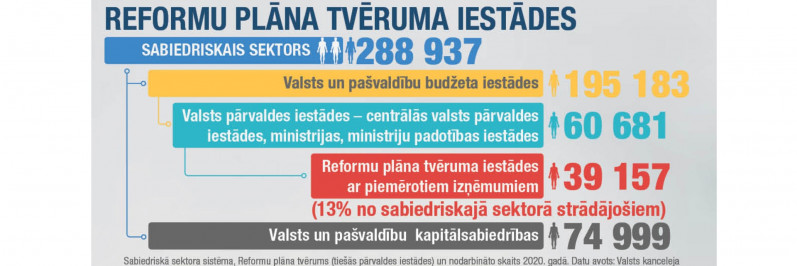
- The scope of the reform is too narrow covering only part of the state administration institutions and 21% of employees in public sector.
When assessing the implementation of the State Administration Reform Plan approved by the government in 2017 with the aim of creating an efficient, accountable and flexible state administration, the audit findings allow conclude that some of the set performance indicators have been achieved, but the reforms have not been effective in general as the use of term ‘reforms’ created expectations of high-quality change in entire state administration that have not materialised.
Reducing the number of people employed in state administration as the “loudest measure” of the Reform Plan should also be evaluated as a “unique selling point” rather than a meaningful change. The promised formal reduction of 6% of employees has even been exceeded (3.2 thousand workloads or 7.6 % have been reduced in 3 years). However, due to exceptions, methodologies and the creation of new positions, the number of employees in state budget institutions has not changed significantly during the reform, as they employed about 60,000 employees before and after the reform. In addition, the reduction in the workload is seen as a separate outcome of the reform, although it would make sense to assess the dynamics of the reduction in the light of the new posts created.
"Measuring and demonstrating individual redundancies can be satisfying for society, but it is not a reasonable indicator if new posts are allocated at the same time and existing institutional functions and tasks are not reviewed. The size of state administration must be assessed in the context of its quality and content - functions and services, because a reduction in the number of employees does not in itself reduce the total expenditure of state administration and does not guarantee services that are more efficient. Namely, the dynamics of the number of employees must be related directly to the review of the scope and content of the capacity of state administration. The audit found that this was not the focus of this reform. Moreover, this is not the first audit by the State Audit Office that highlights a fundamental problem in state administration - the lack of high-quality data. How can one reform something when there is no data on the actual costs of functions and tasks?” emphasizes Ms Inga Vilka, Member of the Council of State Audit Office, Director of the Fourth Audit Department.
Amendments to the Remuneration Law are late and it is not a 'silver bullet' for reforming; difficult decisions yet to come
To increase the competitiveness of salaries, a system of remuneration incomprehensible and unacceptable to the public and the employees of the state administration itself is maintained for a long time in state administration. As a result, the importance of bonuses and premiums as a motivational tool for achieving results has diminished or even disappeared. The need for changes in the state administration remuneration system has been emphasised for more than 10 years. Unfortunately, without adopting the long-awaited Remuneration Law already at the end of 2017, as originally planned, the reform lost its essence and main impetus, to increase resources during the reform period by reducing the number of employees, reviewing annual expenditure, centralizing support functions by diverting the resulting resources to increase remuneration. On the other hand, it was just one of 10 reform measures and should not be seen as a 'magic wand' that would solve everything and guarantee the success of reforms.
The amendments to the Remuneration Law approved at the end of 2021 provide for a new monthly salary scale for state administration employees and increase the remuneration of a number of senior state officials significantly (for example, the President of Latvia, Members of Parliament, Ministers). If the increase in remuneration for senior government officials is guaranteed each year as the welfare of the state increases, then the increase for other state administration employees will largely depend on the funding or remuneration fund available to a particular institution, which differs significantly among the state institutions. Because of this fundamental problem, a distinction has historically occurred between 'rich' and 'less rich' institutions. The current approach implies the attitude of politicians indirectly that some ministries take precedence over others and that there is no political will to settle the issue.
The changes in the Remuneration Law also do not fulfil the promise of the reform to link the amount of remuneration to senior executives with key performance indicators, which has been consistently insisted by the State Audit Office.
Also, the reform has not addressed the long-standing issue of the practice of senior public officials to merge several positions that the public assesses negatively as it raises questions about the ability of a public official to perform and combine a full-time senior position in a ministry or institution with a council or board member in a state-owned enterprise.
Increasing the efficiency of state administration processes remains a major challenge
To increase the efficiency of state administration processes, the Reform Plan included measures to streamline internal processes. The audit concludes that the cooperative activity of introducing project team work to implement government priorities has not been implemented, nor has the zero-bureaucracy approach been implemented. The centralisation of support functions has been a long-standing issue and is taking place gradually, but the level of centralisation is still low (for example, accounting is centralised in about a third of state institutions). During the reform period, centralisation in the departments took place without a decision of the Cabinet of Ministers, additional funding and clear targets and benefits, thus it was carried out depending on the funding available in each department, IT systems, understanding and motivation to review the existing approach and make changes.
Why did not one govern the reforms effectively?
Ms Vilka mentions various reasons, “Political support for the reform, although consolidated in the declarations and action plans of the last three governments, actually failed to implement the reforms, and thus decisive decisions for the development of state administration were not taken in time. The audit clearly highlighted the “weakness” of the State Chancellery as the centre of government and the responsible institution, that is, limited powers and opportunities to ensure appropriate and timely action by the ministries in the implementation of the reform.” She also emphasises, “The parliament and the government must also be actively involved in solving problems to create an efficient, accountable, and flexible state administration in Latvia. Otherwise, the expected reforms are missing and one must criticise both the reform plan and its governance.”
There is a lack of a clear system of objectives and performance indicators for the full-fledged assessment of the reform, which would allow assessing specific impact of the measures taken in achieving the objective. Cumbersome data collection and processing, a lack of high-quality data, continued harmonization of legislation, including the desire of departments for beneficial exceptions, competition among departments for financial and human resources, high staff turnover in state administration and the State Chancellery itself which affected the ability to continue the started progress hampered the progress of reform. The Reform Plan envisaged the implementation of measures within three years from the end of 2017 to 2020, but several significant changes are considered only at the end of the audit in 2022. According to the State Audit Office, the implementation of the measures has taken a long time and is not related to the COVID-19 pandemic.
The scope of the reform plan was too narrow
The Reform Plan covers part of the state administration (ministries and their subordinate institutions), but it does not cover independent and autonomous state institutions, local and regional governments, municipal institutions, planning regions, as well as state-owned and municipal enterprises. The State Audit Office draws the Saeima’s attention to the need to find a solution so that issues important to the public, along with changes in direct state administration, are tackled and coordinated in the entire public sector. One should also note that the reform does not cover such a material issue as the civil service and its further development.
In addition to the irregularities identified during the audit, the auditors also noted the positive aspects of the reform such as the measures to change culture and thinking in state administration, which are continuing to be implemented. It should be mentioned that the crisis caused by COVID-19 during the reform exacerbated existing problems in state administration, but the state institutions managed to adapt to the new situation by ensuring the continuity and availability of services in those circumstances.
After the conclusion of the audit, on 8 February 2022, the Cabinet of Ministers reviewed and adopted the informative report of the State Chancellery on the results of the State Administration Reform Plan. In the opinion of the State Audit Office, the assessment of the results is too optimistic.
Based on the findings and conclusions of the audit, there are eight recommendations provided to the State Chancellery and one proposal submitted to the Cabinet of Ministers. The deadline for implementation of the audit recommendations is 2024, which has also been agreed by the audited entity, the State Chancellery.
Additional data